Pre-sale and custom
Pre-sale, custom and second-hand badges: the listings where OrientDig's usual rules step aside
Most of OrientDig's timing and return rules assume a ready-made new item. These three badges switch some of those rules off, and the gaps they leave are yours to manage.
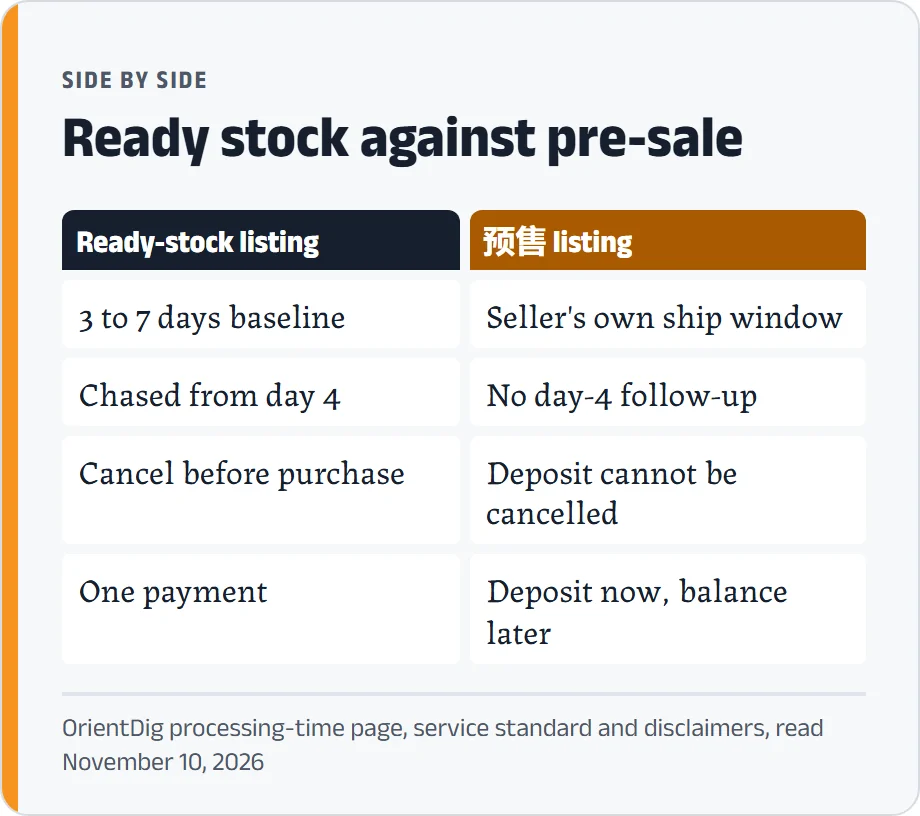
预售 and 定金: the seller's calendar replaces the usual wait
A 预售 (yù shòu) listing sells something the seller does not have yet. It usually shows two prices, a 定金 deposit now and a 尾款 balance later, and a window when shipping starts, often weeks away. Two OrientDig pages step aside for these items. The processing-time page excludes "part of the customized products and pre-order items" from its three-to-seven-day baseline, and the service standard's follow-up rule, the first chase "within the 4th day", ends with "Note: Except for pre-sale / deposit-paid orders".
So no chase starts on day four, and an order that sits in Purchased for three weeks is normal if the listing said so. Plan around the date on the listing, not around any figure on this guide. Keep a screenshot of the listing's ship-date line when you pay; if the seller slips, that is what the purchaser can point to.
A deposit order cannot be called back
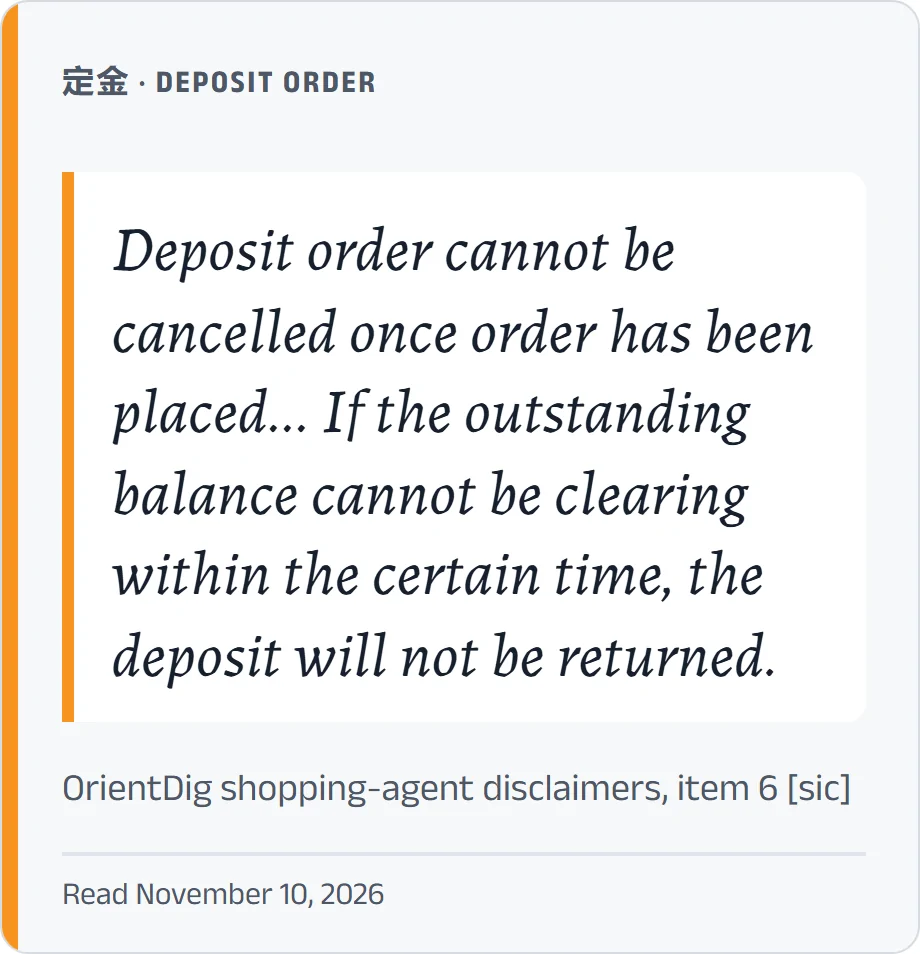
The hardest rule for a 定金 listing is in OrientDig's shopping-agent disclaimers, under "Deposit order":
deposit order cannot be cancelled once order has been placed, and meanwhile you have to follow up the seller's issued information and clear the outstanding balance
It continues: "If the outstanding balance cannot be clearing within the certain time, the deposit will not be returned." Two things follow. First, a deposit is a commitment from the moment the purchaser places the order; changing your mind about size or color is not a reason the seller has to accept. Second, the balance is due on the seller's schedule, which may be weeks later, and you have to be reachable and funded then. Top up your OrientDig balance ahead of the balance date and watch your messages; the disclaimer puts the job of following the seller's notices on you.
定制 work: the details are settled with the seller, by you
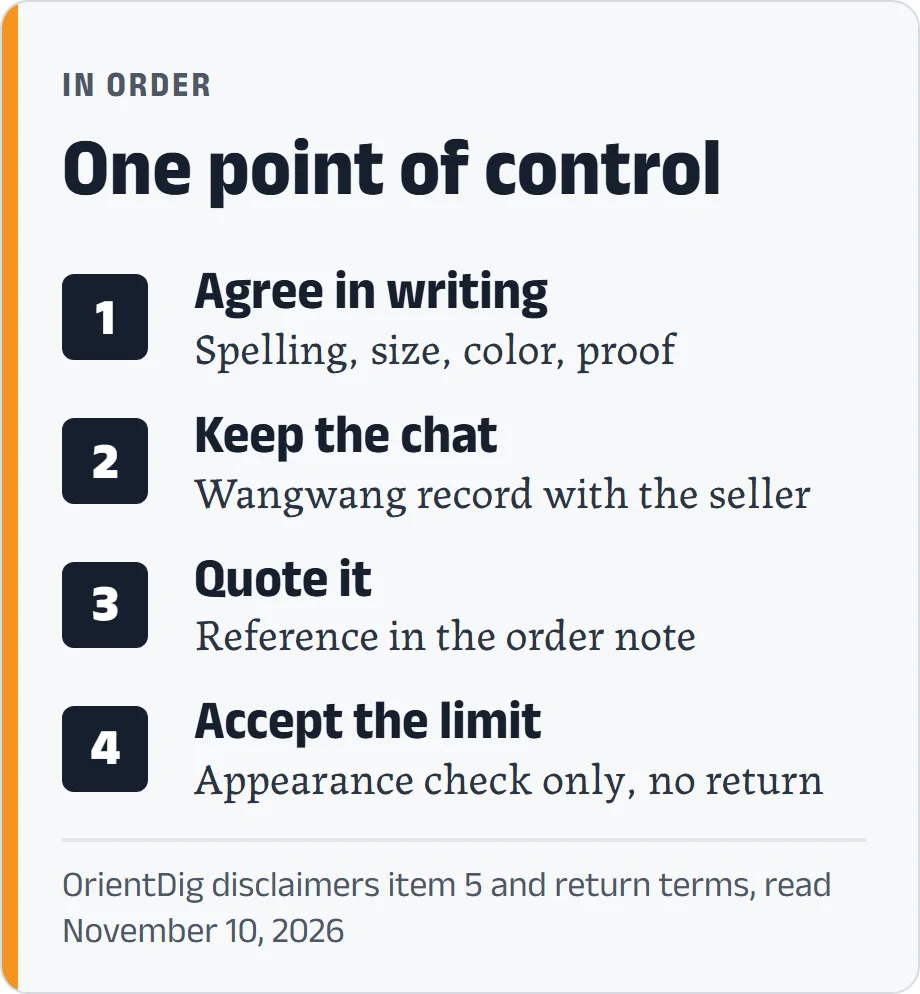
定制 (dìng zhì) covers anything made for you: engraving, name and number printing, made-to-measure clothing, prescription lenses, a logo on a 1688 order. OrientDig's disclaimers handle it in three sentences. You negotiate "with the seller directly so that your requirements would be meet". Once agreed, you give OrientDig "the number, information, or signs of Wangwang chatting with the seller", Wangwang being the chat tool Taobao sellers use. And because "We cannot do professional inspection for these items", any loss from the result is yours.
The return terms then close the other door: customized products head the five-day guarantee's exclusion list. Put together, a custom order has one point of control, the conversation before you pay. Agree the spelling, size, color and any proof photo in writing, keep that chat, and quote its reference in your OrientDig order note so the purchaser can match it. The warehouse photos will show the item's appearance; they cannot confirm that a lens prescription or a measurement is right.
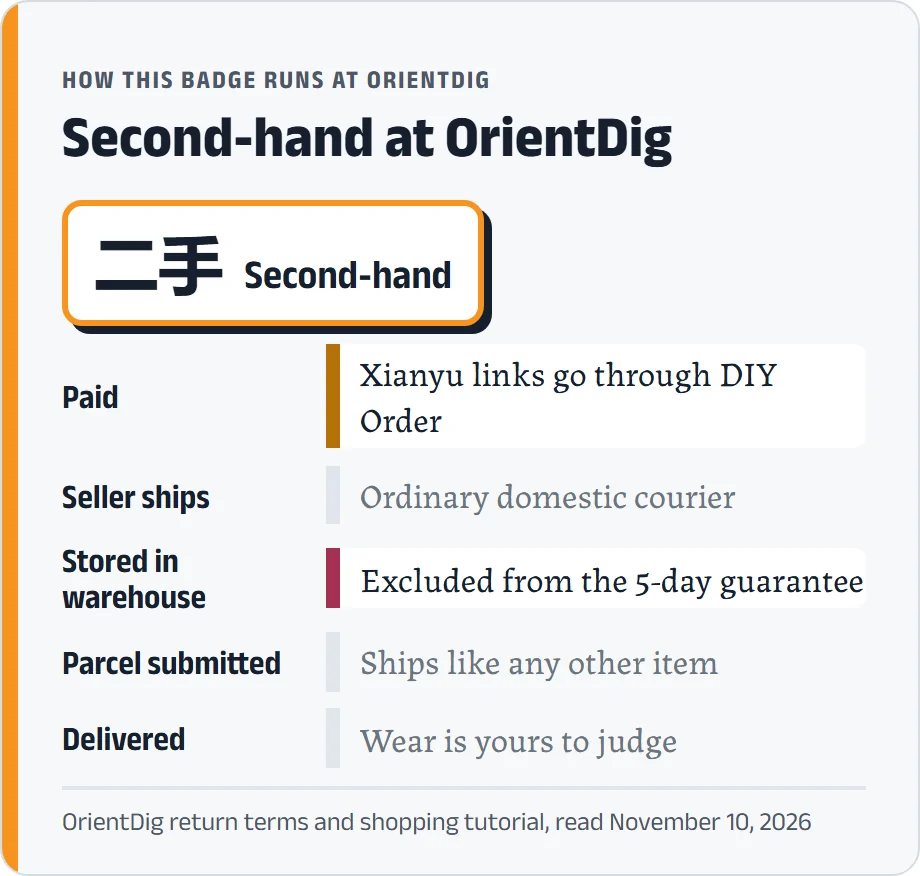
二手 listings never had a return guarantee here
二手 (èr shǒu) means used. OrientDig's return terms list "second-hand products" among the exclusions, so whatever a listing says about returns, a used item cannot go back through the five-day guarantee. The warehouse's basic check covers color, large damage, stains, size, model and version, which is useful for spotting a missing part or an obvious mark, but wear you only notice in use is outside it.
Most second-hand listings in China live on Xianyu (闲鱼), and those links cannot be pasted into OrientDig: its tutorial sends Xianyu, along with Pinduoduo and Yupoo, through a manual DIY Order form, and its first-order page warns that items from platforms it cannot verify may run into "an extra service fee, unable to purchase, and shipping risks". If a used item matters to you, ask the seller for extra photos of wear before you pay, because after storage you will only be able to look, not send it back. The arrival photos page covers what to look for.
When two of these badges share a listing
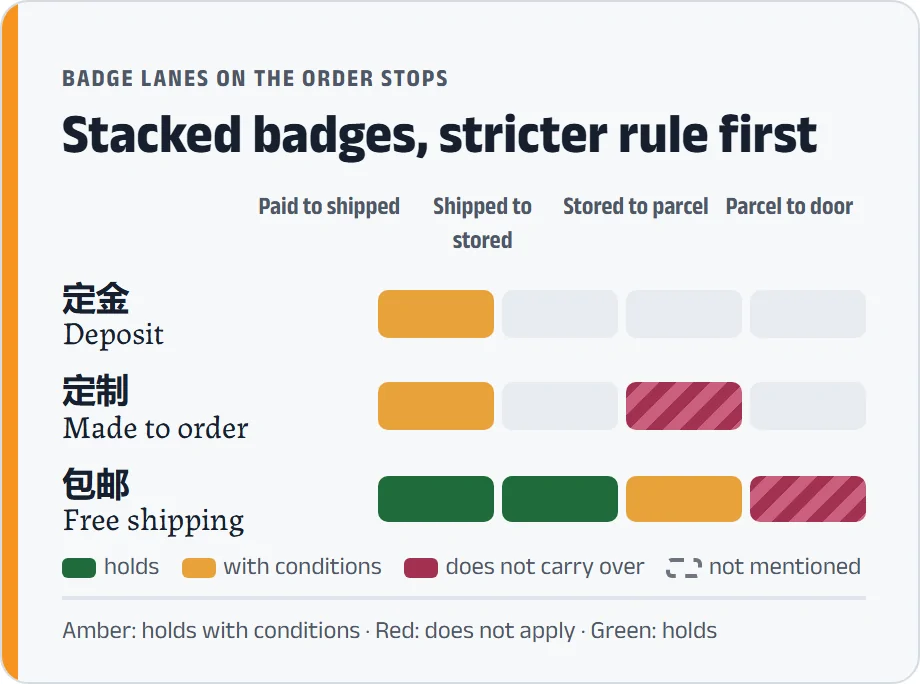
Badges stack, and when they do the stricter rule wins. A made-to-order item sold on deposit, common for custom jewelry and team kits, carries both the deposit lock and the custom exclusion: it cannot be cancelled once ordered and cannot be returned once stored. A 预售 item with 包邮 still gets its free domestic courier, just on the seller's later date, and the 48-hour or 3-to-7-day ideas do not apply to it at all. A second-hand item that also shows 7天无理由, which happens on some Taobao resale stores, is still excluded by OrientDig's terms; the seller's tag does not override the exclusion list.
The badge strip draws these combinations on one line, which makes the overlap easier to see than reading three rule pages side by side.