Spreadsheets and agents
Spreadsheets and agents: checks for the catalogue you browse and the buyer you pay
Two choices come before any listing: where you find products, and who buys them for you. Both can be judged with a short list of checks.
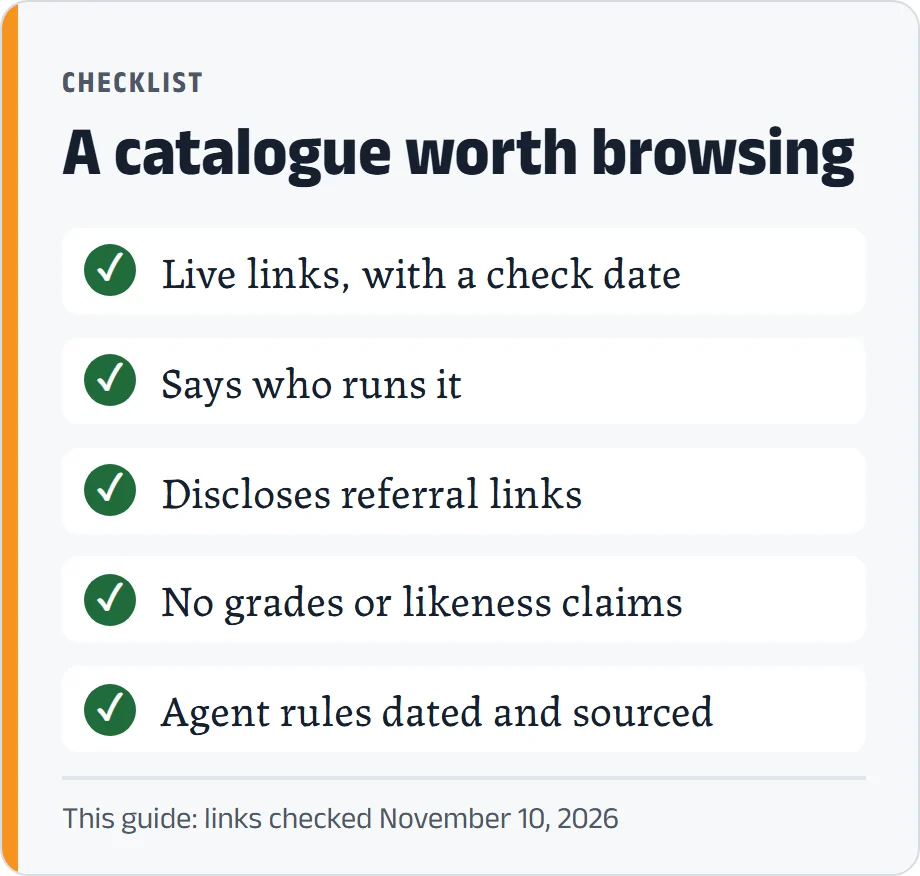
Five marks of a product catalogue worth your time
Here, a spreadsheet site means a product catalogue: cards for items buyers have found, sorted by category, each leading to the original listing. Choosing a good spreadsheet comes down to upkeep and honesty, not size. Its links should open live categories or listings, and it should say when they were last checked. It should say who runs it and whether its agent links carry referral codes. It should describe products plainly, without grades or promises about how close an item is to something else. And it should keep agent rules separate from product picks, with dates and sources.
This guide holds itself to the same list: shelf links checked on November 10, 2026, a named contact address, a disclosed referral link to OrientDig, and every rule quoted with its date. If you find a page that fails one of those, the about page says how to report it.
Agent paperwork worth reading before money moves
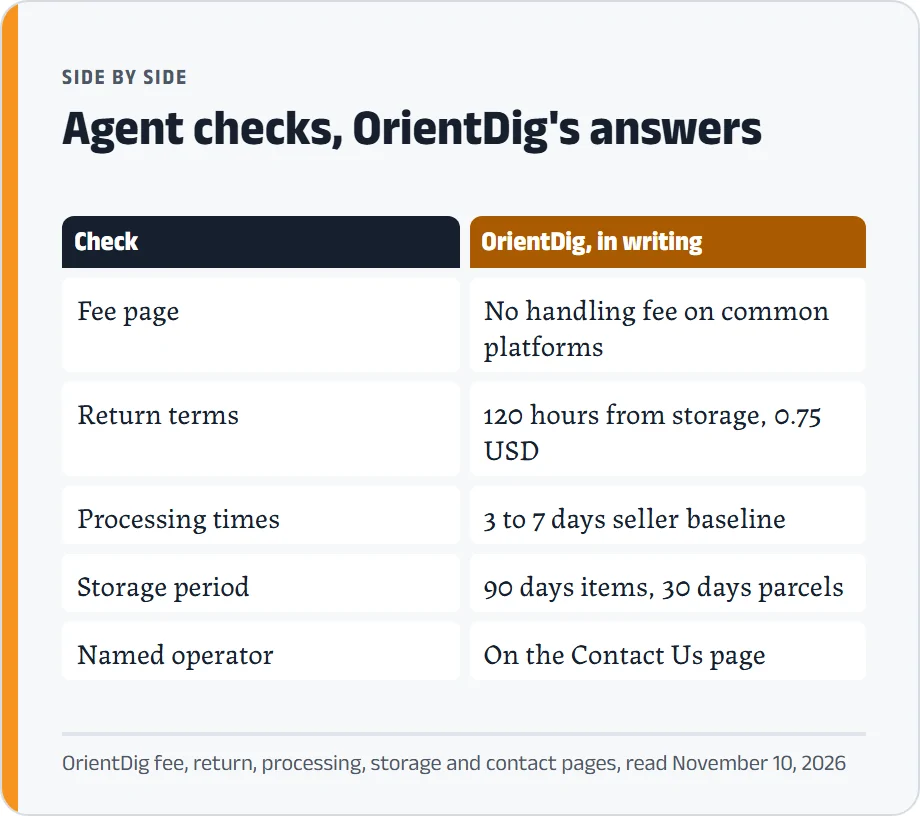
Choosing an agent comes down to reading what it has put in writing. Look for a fee page that lists what is free and what is not; a written return policy with a window, fees and the seller's role; stated processing times; a storage period with what happens after it; a company named on the contact page; and support routes for orders as well as accounts. An agent that writes these down can be held to them. One that only has banners cannot.
For badge readers, add one more: does the agent say what happens to seller badges? OrientDig's answers, as read on this guide, are in the right-hand column of the figure: written return terms with a 120-hour window, a processing-time page with seller baselines, a 90-day storage period, a named operator and ticket support for orders.
Where other agents charge, and the badge questions they share
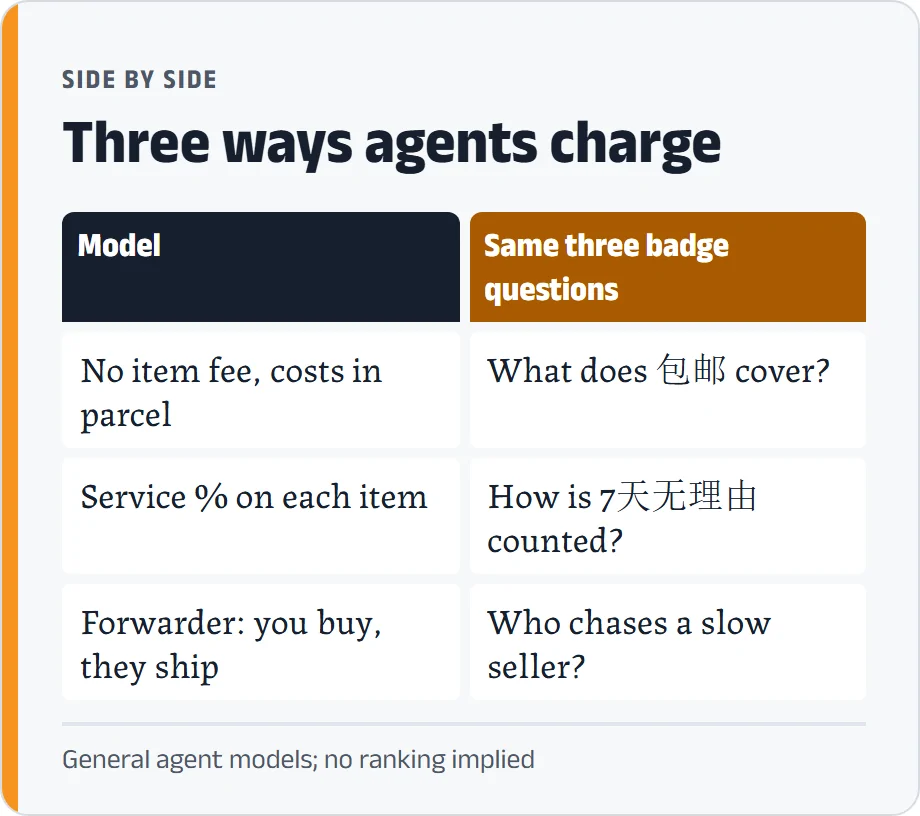
Plenty of other shopping agents buy for customers abroad, and their names turn up on the same product catalogues. They differ mainly in where they charge. Some, like OrientDig, take no handling fee on the item and earn on the parcel. Others add a service percentage to each item and charge less for shipping. A third group, forwarders, skip the buying step entirely; you place the seller order and they only ship what turns up.
The badge question is the same at every one of them. Each puts a warehouse between seller and buyer, so each has to say what 包邮 covers, how 7天无理由 is counted and who chases a slow seller. When comparing, read those three answers in writing and note the date. A different agent can be the right choice for your basket; it is the written rules that let you know before paying rather than after.