
Using OrientDig
Using OrientDig as the buyer behind your OrientDig Spreadsheet finds
Who OrientDig is, the statuses a first order moves through, and an honest view of when it suits a badge-conscious buyer and when it does not.
Illustrated Guide · 10 steps
Use the listing as a checklist from purchase to arrival

Choose how to find the item
Paste a supported listing, search by product name or upload an image on OrientDig. Check DIY for unsupported links.
Record the selected option
Check the listing’s badges, pick the right color, size and quantity, and verify the seller’s conditions.
Review the first payment
Confirm the product cost and domestic shipping to the warehouse.
Let the agent place the order
OrientDig buys from the seller. Use the order notes if you need the agent to confirm an option.
Compare the arrival photos
Check appearance and visible accessories against the listing. Ask for another angle if a detail is unclear.
Select warehouse items for delivery
Choose the items to include, confirm your address and review available routes, packing and optional services.
Pay the international estimate
The deposit depends on destination, shipping line and estimated weight. Check the final charge once the parcel has been measured.
Wait for dispatch
The warehouse combines, packs and weighs the items selected for the parcel.
Use the tracking status
Check My Parcel for handoff and carrier updates as the parcel travels.
Inspect at delivery
Confirm receipt after checking the items. Contact support from the parcel record if you need to raise an issue.
Warehouse photos can show the item’s visible condition and accessories. For a return or refund, contact the order agent before international dispatch and check the seller’s terms.
Official OrientDig shopping guideOrientDig buys on Chinese platforms in your name
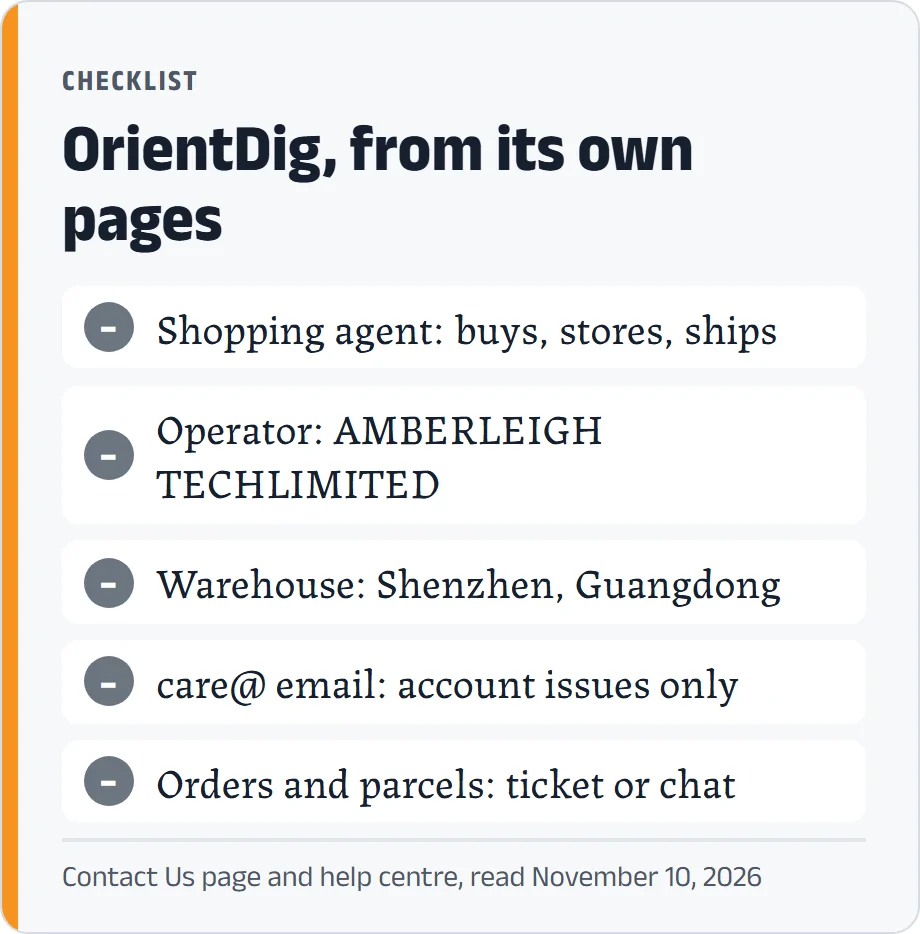
In plain terms, OrientDig orders from Chinese marketplaces under its own account for you, takes delivery in Shenzhen, photographs what arrives, and later sends the items abroad in parcels you assemble. Money moves twice: once for the item with its domestic courier, once for the parcel. Links from Taobao, Tmall, 1688 and Weidian can be pasted directly, according to its tutorial.
The company named on OrientDig's Contact Us page is AMBERLEIGH TECHLIMITED (the operator's own spelling, read November 10, 2026), and OrientDig's service terms place disputes under the laws of the UK. Its help centre puts the warehouse in Shenzhen, Guangdong. Support is split by topic. The Contact Us page limits [email protected] to "account-related issues only"; anything about money, orders or parcels belongs in a ticket raised from your account, or in the live chat. The site itself runs in ten interface languages, English included.
An account, a display currency and a balance
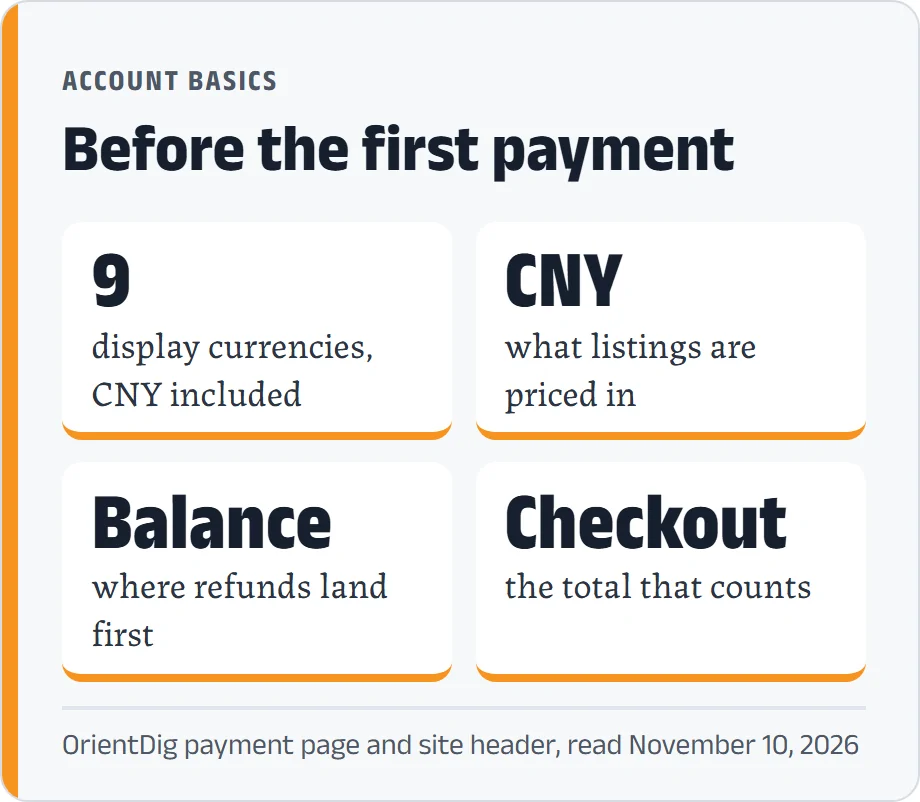
Signing up takes an email address, a password and a tick against OrientDig's terms. The sign-up link on this guide includes a referral code, which pays for the guide; the account you get is identical either way. Once in, the currency selector in the header switches prices between CNY and eight others (USD, EUR, GBP, AUD, CAD, PLN, NZD and CHF). Listings are always priced in CNY underneath; the other currencies are a display.
Payments can be made per order or from an account balance, and refunds of any kind come back to that balance first. OrientDig's payment page lists channels by currency and warns that "payment channels may occasionally be suspended", so the options on your checkout screen are the ones that count. It does not publish a percentage for card or wallet charges, and this guide does not guess one: the total on the checkout screen is the figure to judge.
Statuses a first order passes through, link to doorstep
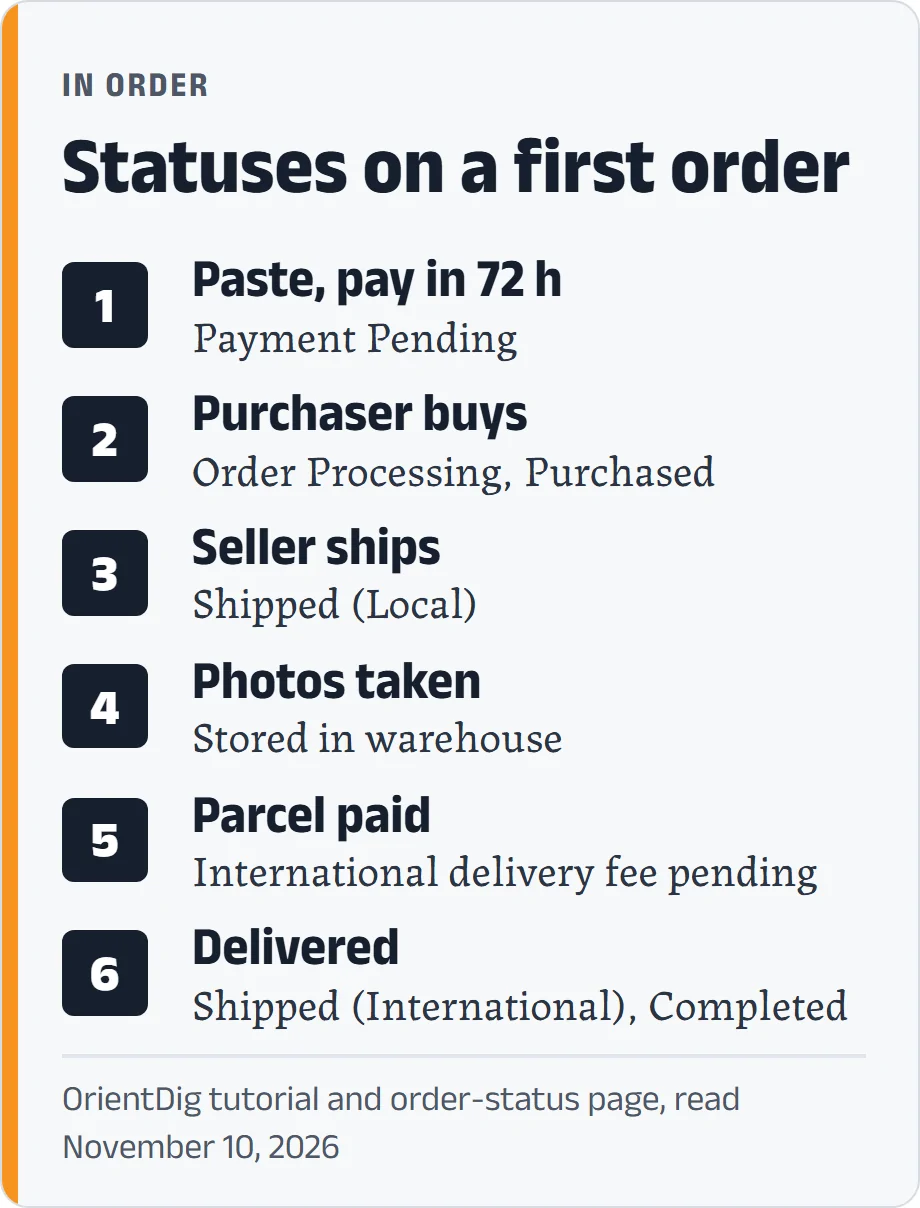
These are the steps as OrientDig's tutorial and status page describe them, with the badge question at each one. Paste the listing link into OrientDig's search box; the product page loads with its options and the domestic freight figure, which a 包邮 listing shows as 0.00. Choose options, add a message only if you have a special requirement, and submit. The order sits in Payment Pending, which you have 72 hours to pay.
Once paid, it shows Order Pending, then Order Processing, while a purchaser checks it and buys from the seller, then Purchased. This is where 现货 is tested and where 48小时内发货 starts to mean something. When the seller ships, the status becomes Shipped (Local); on arrival it goes to Received, then Stock arrived after inspection and weighing, then Stored in warehouse, with photos. The 120-hour return window opens here.
From the warehouse page you pick the stored items to send, choose packaging options and a shipping line, and submit a parcel. It waits as International delivery fee pending until you pay, then Processing, Shipped (International) and finally Completed. Links from Xianyu, Pinduoduo or Yupoo take the manual DIY Order route instead of the paste step.
Why OrientDig suits badge readers, plus its weaker points
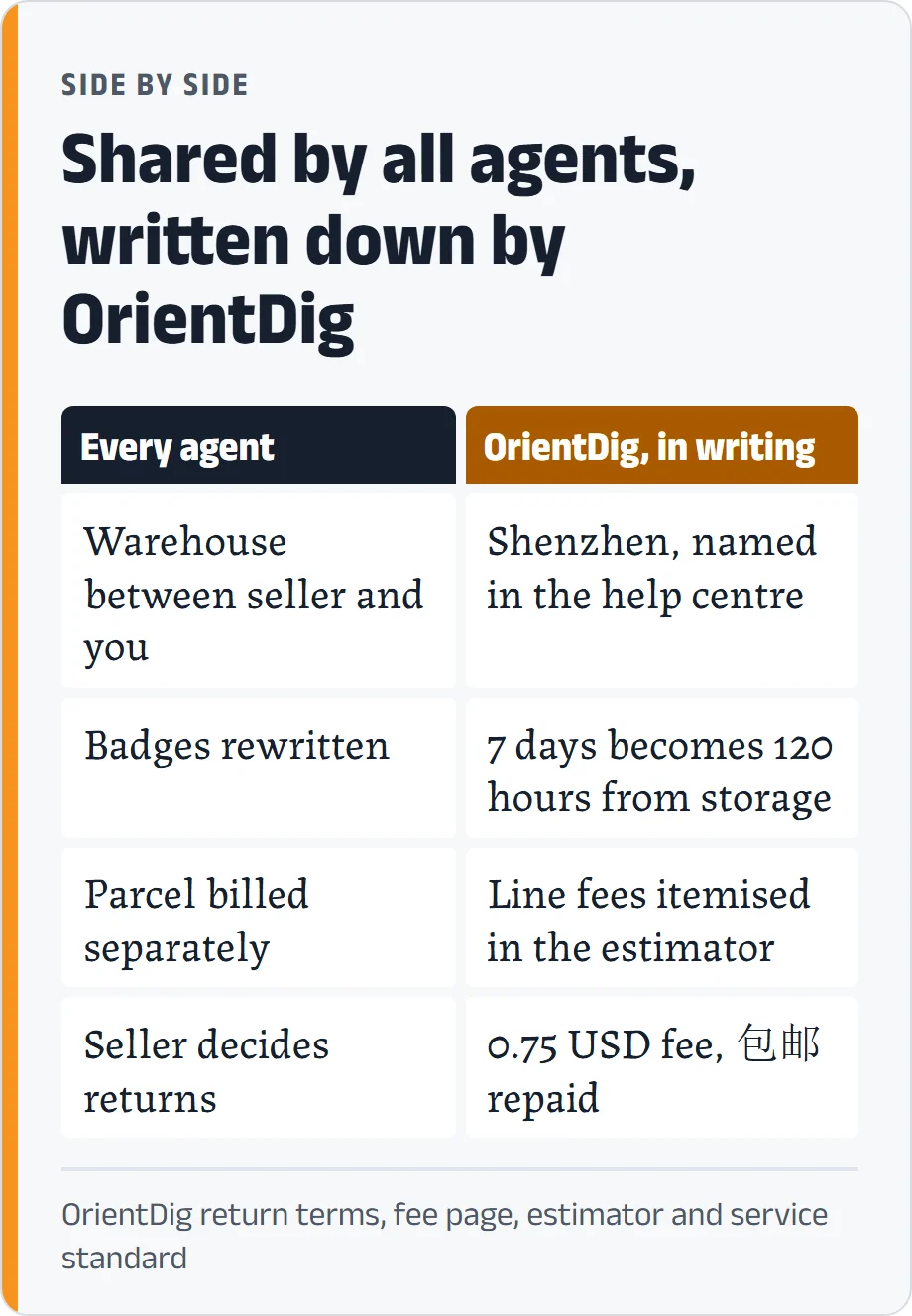
What is the same anywhere. Every shopping agent puts a warehouse between the seller and you. That means every agent rewrites 包邮, 7天无理由 and 48小时发货 in some way, every one charges for the international parcel separately, and every one depends on the seller for returns. None of that is special to OrientDig, and a guide that sold it as special would be misleading you.
What OrientDig does differently. It writes the badge translation down. The return terms state the seven-to-five-day conversion, the 120-hour limit, the 0.75 USD fee and the rule that 包邮 is repaid on a return. The service standard commits to a first seller follow-up within day four. Its fee page rules out a handling fee for the common platforms, yet its shipping estimator shows each line's operation fee and service fee (on November 9, 2026: 15 CNY operation and 10 CNY service, per parcel), so the costs sit in the parcel rather than in the item. For a buyer who reads badges closely, rules in writing are worth more than a generous-sounding banner.
Where another agent could serve you better. Buy mostly from Xianyu or Pinduoduo, and every single order becomes a DIY Order. If you expect to return things often, compare written return windows and fees before choosing; OrientDig's window is 120 hours from storage and the seller decides. If you need many close-up photos of each item, budget for detailed photos at 0.15 USD each beyond the three standard ones.